 English
 ISO 27001 Foundations
ISO 27001 Foundations is an introductory training course that provides a basic understanding of the ISO/IEC 27001 standard for Information Security Management Systems (ISMS). It explains the key concepts, structure, and requirements of the standard, including risk management, security controls, and continuous improvement processes. The course is designed to help learners understand how organizations protect sensitive information, manage security risks, and implement a structured approach to information security. It is suitable for beginners who want to build a foundation in information security and prepare for more advanced ISO 27001 or cybersecurity certifications.
- 4.8/5.0
- 800 Enrolled
- Last updated Jul 02, 2026
Course Overview
- In an era defined by pervasive digital transformation and escalating cyber threats, the integrity, confidentiality, and availability of information are paramount. Organizations globally face an urgent imperative to safeguard their critical assets, maintain customer trust, and ensure regulatory compliance. This 'ISO 27001 Foundations' course serves as your essential guide to understanding and appreciating the internationally recognized standard for Information Security Management Systems (ISMS).
- This comprehensive program is meticulously designed to demystify ISO 27001, providing participants with a solid grounding in its core principles, requirements, and benefits. We will explore the fundamental concepts of information security, delve into the structured framework of the standard, and illuminate how it empowers organizations to systematically manage and reduce information security risks. Through a blend of theoretical knowledge and practical insights, you will gain clarity on what an ISMS entails and why its implementation is crucial for modern enterprises.
- By the end of this course, you will not only comprehend the 'what' and 'why' of ISO 27001 but also acquire the foundational knowledge necessary to contribute effectively to an ISMS implementation or maintenance initiative within any organization. This course is an invaluable stepping stone for professionals aspiring to build resilient security postures, navigate complex compliance landscapes, and advance their careers in the ever-evolving field of information security. Join us to unlock the power of ISO 27001 and become a pivotal asset in securing the digital future.
Course Outlines
Module 1: Introduction to Information Security and ISO 27001
- Fundamentals of Information Security: Confidentiality, Integrity, Availability (CIA)
- Understanding Information Security Threats, Vulnerabilities, and Risks
- The Importance of an Information Security Management System (ISMS)
- What is ISO/IEC 27001: History, Purpose, and Benefits
- The ISO 27000 Family of Standards: An Overview
- Key Terminology and Definitions within ISO 27001
Module 2: Understanding the ISO 27001:2022 Standard Structure - Part 1
- The High-Level Structure (HLS) / Annex SL Explained
- Clause 4: Context of the Organization (Understanding internal and external issues, interested parties, scope of the ISMS)
- Clause 5: Leadership (Management commitment, policy, roles, responsibilities, and authorities)
- Clause 6: Planning (Actions to address risks and opportunities, information security objectives and planning to achieve them)
- Risk-Based Thinking in ISO 27001
Module 3: Understanding the ISO 27001:2022 Standard Structure - Part 2
- Clause 7: Support (Resources, competence, awareness, communication, documented information)
- Clause 8: Operation (Operational planning and control, information security risk assessment, information security risk treatment)
- Clause 9: Performance Evaluation (Monitoring, measurement, analysis, evaluation, internal audit, management review)
- Clause 10: Improvement (Nonconformity and corrective action, continual improvement)
- The Plan-Do-Check-Act (PDCA) Cycle in ISMS
Module 4: Information Security Risk Management Principles
- The Importance of Risk Management in ISO 27001
- Overview of Information Security Risk Assessment Methodologies
- Identifying Assets, Threats, and Vulnerabilities
- Evaluating Risks: Likelihood and Impact
- Information Security Risk Treatment Options and Strategies
- Developing a Statement of Applicability (SoA)
Module 5: Introduction to ISO 27002 and Annex A Controls
- The Relationship Between ISO 27001 and ISO 27002
- Overview of ISO 27002:2022 Control Families (Organizational, People, Physical, Technological Controls)
- Key Control Examples from Annex A of ISO 27001:2022
- Selecting and Justifying Applicable Controls
- Developing Control Objectives and Implementing Controls
- Practical Application of Controls to Mitigate Risks
Module 6: ISMS Implementation Roadmap and Certification Process
- Phases of ISMS Implementation: From Planning to Operation
- Key Roles and Responsibilities in an ISMS Implementation Project
- Understanding the ISO 27001 Certification Process
- Preparing for Internal and External Audits
- Maintaining ISMS Compliance and Continual Improvement
- Common Challenges and Success Factors in ISMS Implementation
Course Objectives
- Describe the fundamental principles, concepts, and benefits of information security management.
- Explain the purpose, scope, and objectives of the ISO 27001 standard and its relationship with other ISO 27000 family standards.
- Identify and interpret the key requirements of an ISO 27001-compliant Information Security Management System (ISMS) based on the 2022 version of the standard.
- Outline the essential steps involved in establishing, implementing, maintaining, and continually improving an ISMS.
- Recognize the importance of information security risk assessment and treatment within the context of ISO 27001.
- Differentiate between the clauses of ISO 27001 and the information security controls outlined in Annex A (referencing ISO 27002).
- Discuss the critical role of leadership commitment, documented information, and performance evaluation in a successful ISMS.
- Prepare foundational knowledge for pursuing further ISO 27001 implementation, auditing, or lead implementer certifications.
Course Prerequisites
- Basic understanding of IT concepts and common business processes.
- General awareness of the importance of information and data protection.
- Strong analytical and problem-solving skills.
- Attention to detail and a commitment to ethical practices.
- No prior experience with ISO 27001 specifically is required, making this course ideal for beginners in the field.
Course Schedule
| Date | Days Left | Training Location | |
|---|---|---|---|
No schedules available | |||
Our Customer Reviews
4.8
(*)(*)(*)(*)(*)
Excellent
(*)(*)(*)(*)(*)
(*)(*)(*)(*)( )
( )( )( )( )( )
( )( )( )( )( )
( )( )( )( )( )
This course includes
- Duration16 h
- VendorPECB
- CategoryCyber Security
- CertificateYes
Similar Courses
Dora Lead Manager
The DORA (Digital Operational Resilience Act) Lead Manager course equips senior professionals with the skills and knowledge needed to oversee, manage, and ensure compliance with the DORA framework in financial institutions and related ICT service providers. This program covers operational resilience strategies, ICT risk management, incident handling, reporting requirements, and oversight of third-party providers, enabling participants to lead their organizations in meeting the EU’s regulatory expectations effectively.
- 40 h 4.9 (2000)
ISO 42001 AI lead implementer
The ISO/IEC 42001 Lead Auditor course equips professionals with the knowledge and skills to conduct and lead Artificial Intelligence Management System (AIMS) audits in compliance with ISO/IEC 42001. Participants will learn to apply internationally recognized audit principles, manage audit programs, and ensure AI governance aligns with ethical, legal, and organizational requirements. The course prepares attendees for certification as an ISO/IEC 42001 Lead Auditor, empowering them to assess AI systems for compliance, risk management, and continuous improvement.
- 40 h 4.9 (2000)
NIS 2 Directive Lead Implementer
The NIS 2 Directive Lead Implementer Certification course is designed for professionals seeking to guide organizations through the complex landscape of the European Union's updated Network and Information Security (NIS 2) Directive. This comprehensive program provides a deep dive into the directive's requirements, focusing on practical implementation strategies for enhanced cybersecurity and resilience across critical sectors. Participants will gain the expertise necessary to establish, implement, maintain, and continually improve an organization's NIS 2 compliance framework. This course adopts a structured approach, covering governance, risk management, incident response, technical measures, and legal aspects. It equips lead implementers with the tools and knowledge to conduct gap analyses, develop robust security policies, manage supply chain risks, and ensure effective reporting, ultimately fostering a secure digital environment in line with EU mandates. Through real-world scenarios and best practices, attendees will be prepared to lead their organizations towards full compliance and bolster their overall cyber posture.
- 40 h 4.9 (2000)
ISO27032 Lead Cyber Security Manager
The ISO/IEC 27032 Lead Cybersecurity Manager course equips participants with the knowledge and skills to build and manage an effective cybersecurity program. It covers key cybersecurity principles, governance models, and the relationship with domains like information security and CIIP. Participants learn to identify, assess, and mitigate cyber risks using ISO/IEC 27032 and the NIST CSF. The course also develops capabilities for incident response, policy development, and strengthening cyber resilience. Ideal for cybersecurity and information security professionals seeking practical leadership skills.
- 40 h 4.9 (3000)
Cybersecurity Maturity Model Certification (CMMC)
The CMMC Certified Professional (CCP) course provides a solid understanding of the CMMC framework, its structure, and its requirements for Defense Industrial Base (DIB) organizations. It covers CMMC maturity levels, domains, practices, and stakeholder roles, as well as the relationship with key standards like NIST SP 800-171 and ISO/IEC 27001. Participants learn how to implement cybersecurity controls, navigate the CMMC ecosystem, and understand assessment and accreditation processes. This course prepares learners to support organizations in achieving CMMC compliance. It also serves as the prerequisite for becoming a Certified Assessor or Certified Instructor.
- 32 h 4.7 (2374)
You may also like
Check out most 🔥 courses in the market
Dora Lead Manager
The DORA (Digital Operational Resilience Act) Lead Manager course equips senior professionals with the skills and knowledge needed to oversee, manage, and ensure compliance with the DORA framework in financial institutions and related ICT service providers. This program covers operational resilience strategies, ICT risk management, incident handling, reporting requirements, and oversight of third-party providers, enabling participants to lead their organizations in meeting the EU’s regulatory expectations effectively.
4.9
(2000)
ISO 9001 Lead Implementer
The ISO 9001 Lead Implementer training course equips participants with the necessary knowledge and skills to support an organization in establishing, implementing, managing, and maintaining a Quality Management System (QMS) based on ISO 9001:2015. This course provides a practical methodology for the implementation process by applying best practices and aligning with international quality management standards. By the end of the course, participants will gain hands-on expertise in leading implementation projects, managing teams, and preparing organizations for certification audits.
4.8
(3000)ISO 42001 AI lead implementer
The ISO/IEC 42001 Lead Auditor course equips professionals with the knowledge and skills to conduct and lead Artificial Intelligence Management System (AIMS) audits in compliance with ISO/IEC 42001. Participants will learn to apply internationally recognized audit principles, manage audit programs, and ensure AI governance aligns with ethical, legal, and organizational requirements. The course prepares attendees for certification as an ISO/IEC 42001 Lead Auditor, empowering them to assess AI systems for compliance, risk management, and continuous improvement.
4.9
(2000)
AI For End User
This course is a practical, tool-agnostic training program designed for professionals who want to leverage artificial intelligence in their daily work without needing a background in data science or programming. Participants will learn how AI interprets and processes human language, how to interact with AI tools effectively, and how to integrate AI into everyday tasks to enhance productivity, decision-making, and creativity.
4.9
(2457)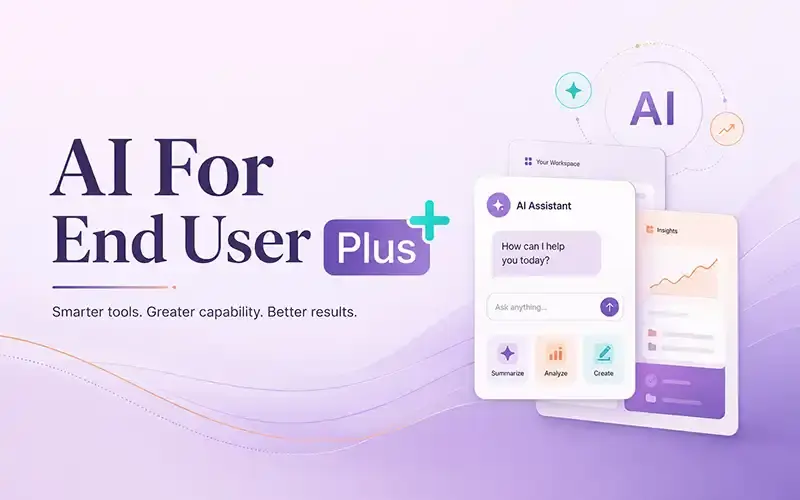
AI For End User Plus
This advanced lesson builds on foundational AI knowledge to help users unlock the full potential of AI tools in personal and professional settings. Learners will explore more powerful features of AI platforms, gain hands-on experience with smart assistants, content generators, and automation tools, and learn strategies for integrating AI into workflows. The course also emphasizes data awareness, ethical use, and decision-making with AI support—empowering users to use AI responsibly and effectively in real-world scenarios.
4.9
(1953)