 English
 ISO 9001 Lead Implementer
The ISO 9001 Lead Implementer training course equips participants with the necessary knowledge and skills to support an organization in establishing, implementing, managing, and maintaining a Quality Management System (QMS) based on ISO 9001:2015. This course provides a practical methodology for the implementation process by applying best practices and aligning with international quality management standards. By the end of the course, participants will gain hands-on expertise in leading implementation projects, managing teams, and preparing organizations for certification audits.
- 4.8/5.0
- 3000 Enrolled
- Last updated Jun 16, 2026
Course Overview
- The ISO 9001 Lead Implementer training course equips participants with the comprehensive knowledge, skills, and confidence needed to support an organization in establishing, implementing, managing, and maintaining a Quality Management System (QMS) in accordance with the ISO 9001:2015 standard. This program combines theoretical understanding with practical applications, offering participants a step-by-step methodology to successfully implement and sustain a QMS that drives continual improvement and customer satisfaction.
- Throughout the course, participants will explore the principles of quality management, the structure and requirements of ISO 9001:2015, and the relationship between ISO 9001 and other management systems. They will also gain insights into the Plan-Do-Check-Act (PDCA) cycle and learn how to apply risk-based thinking and process-based approaches to improve organizational performance.
- This course emphasizes practical implementation techniques, including project planning, stakeholder engagement, documentation development, internal communication, performance evaluation, and management review. Participants will also be guided on how to identify nonconformities, manage corrective actions, and ensure the effectiveness of the QMS over time.
By the end of the training, participants will be able to:
- Lead and manage ISO 9001 implementation projects within their organizations.
- Support organizations in achieving compliance and preparing for certification audits.
- Develop a culture of quality and continuous improvement aligned with strategic objectives.
- Manage teams effectively and ensure alignment with international quality management best practices.
- This intensive and interactive course is ideal for professionals aiming to become qualified ISO 9001 implementers or consultants, as well as managers responsible for quality assurance, compliance, or operational excellence.
Course Outlines
Module 1: Introduction to ISO 9001 and Quality Management Systems
- Overview of the ISO family of standards and their interrelationships
- Definition and purpose of a Quality Management System (QMS)
- Evolution and structure of ISO 9001:2015 (Annex SL framework)
The seven principles of quality management:
- Customer focus
- Leadership
- Engagement of people
- Process approach
- Improvement
- Evidence-based decision making
- Relationship management
- Understanding the role of ISO 9001 in organizational success
- Benefits of ISO 9001 implementation, including improved efficiency, customer satisfaction, and business credibility
Module 2: Understanding ISO 9001 Requirements
- Detailed clause-by-clause interpretation of ISO 9001:2015
- Clause 4: Context of the organization
- Clause 5: Leadership
- Clause 6: Planning
- Clause 7: Support
- Clause 8: Operation
- Clause 9: Performance evaluation
- Clause 10: Improvement
- Understanding organizational context, internal and external issues, and interested parties
- Exploring leadership and commitment in quality management
- Setting quality policies and objectives aligned with strategic direction
- Integrating risk-based thinking and preventive actions
- Managing resources, competence, awareness, and communication effectively
- Understanding documented information and its control
Module 3: Planning the Implementation of a QMS
- Conducting a gap analysis against ISO 9001 requirements
- Establishing a project plan and timeline for implementation
- Defining the scope, objectives, and boundaries of the QMS
- Engaging and managing stakeholders and top management
- Understanding the Plan-Do-Check-Act (PDCA) cycle as a foundation for QMS implementation
- Applying risk-based thinking to identify and manage potential quality risks and opportunities
- Developing a change management strategy for successful adoption
Module 4: Implementing ISO 9001 QMS
- Developing and managing documented information (policies, procedures, work instructions)
- Establishing core and support operational processes
- Aligning process controls with customer and regulatory requirements
- Ensuring competence, training, and awareness across the organization
- Promoting effective internal communication on quality matters
- Managing nonconformities, corrective, and preventive actions
- Creating an environment for continual learning and improvement
- Integrating QMS with other management systems (e.g., ISO 14001, ISO 45001) where applicable
Module 5: Monitoring, Measurement, and Continuous Improvement
- Setting up performance monitoring and measurement mechanisms
- Establishing and interpreting Key Performance Indicators (KPIs) for quality
- Conducting internal audits – planning, execution, and reporting findings
- Managing audit nonconformities and follow-up actions
- Conducting effective management reviews and ensuring strategic alignment
- Leveraging data analysis and performance evaluation for decision-making
- Promoting a culture of continual improvement through root cause analysis, innovation, and feedback loops
Module 6: Certification Audit Preparation and Maintenance
- Understanding different types of audits: internal, external, and certification audits
- Preparing for third-party certification – documentation review, readiness assessment, and pre-audit checks
- The role and responsibilities of the Lead Implementer during the certification process
- Engaging with auditors and responding to audit findings effectively
- Ensuring post-certification maintenance and continual compliance
- Managing surveillance and recertification audits
- Maintaining a living QMS through performance tracking, corrective actions, and periodic reviews
Course Objectives
By the end of this course, participants will be able to:
- Comprehensively understand the ISO 9001:2015 standard requirements and interpret each clause in the context of real-world organizational operations, ensuring full alignment with quality management principles.
- Lead, plan, and coordinate the implementation of a Quality Management System (QMS) in accordance with ISO 9001:2015, including developing project plans, defining roles and responsibilities, and managing resources effectively.
- Conduct detailed gap analyses and risk assessments to identify areas of non-conformity, evaluate potential impacts on organizational performance, and design corrective and preventive actions to close identified gaps.
- Guide organizations through the audit process, including preparing documentation, supporting internal and external audits, addressing nonconformities, and ensuring readiness for certification.
- Develop, document, and maintain essential QMS processes and procedures to establish a culture of quality, compliance, and operational excellence.
- Promote a framework for continual improvement by utilizing performance metrics, customer feedback, and internal reviews to enhance process efficiency and overall quality outcomes.
- Foster leadership and employee engagement in quality initiatives, ensuring that quality objectives are integrated into the organization’s strategy and daily operations.
- Ensure long-term sustainability of the QMS through effective monitoring, evaluation, and alignment with organizational goals and stakeholder expectations.
Course Prerequisites
Prerequisites
- To ensure successful participation in the ISO 9001 Lead Implementer training course, participants are expected to have the following background and knowledge:
- Basic
understanding of quality management principles:
Participants should be familiar with the fundamental concepts of quality management, such as customer focus, leadership, process approach, evidence-based decision-making, and continual improvement. - Familiarity
with ISO standards (preferable but not mandatory):
Prior exposure to ISO standards—especially ISO 9001 or other management system frameworks—will be advantageous. However, newcomers with a willingness to learn are also welcome. - Experience
in management systems or organizational processes:
A background in implementing, maintaining, or auditing management systems, or in overseeing operational or administrative processes, will help participants better understand the practical aspects of QMS implementation. - Recommended
professional experience:
Individuals working in roles related to quality assurance, compliance, process improvement, or organizational development will benefit most from the course content. - Language
and analytical skills:
Good command of English and the ability to analyze organizational processes, interpret requirements, and document procedures will enhance learning outcomes.
Course Schedule
| Date | Days Left | Training Location | |
|---|---|---|---|
Our Student Reviews
4.8
Excellent
This course includes
- Duration40 h
- VendorPECB
- CategoryBusiness Management
- CertificateYes
Course Profile
Similar Courses
Dora Lead Manager
The DORA (Digital Operational Resilience Act) Lead Manager course equips senior professionals with the skills and knowledge needed to oversee, manage, and ensure compliance with the DORA framework in financial institutions and related ICT service providers. This program covers operational resilience strategies, ICT risk management, incident handling, reporting requirements, and oversight of third-party providers, enabling participants to lead their organizations in meeting the EU’s regulatory expectations effectively.
- 40 h 4.9 (2000)
ISO 22301 Lead Implementer
Prepare to establish, implement, and manage a Business Continuity Management System (BCMS) in line with ISO 22301:2019. Learn to identify risks, assess business impacts, and design effective response and recovery strategies. Master proactive business continuity planning to protect critical operations and ensure rapid recovery. Gain skills to comply with international standards and strengthen stakeholder confidence. Be ready to lead BCMS implementation and guide your organization toward ISO 22301 certification.
- 40 h 4.8 (1676)
Lead Disaster Recovery Manager
The Lead Disaster Recovery Manager course provides advanced skills to design, implement, and manage effective disaster recovery (DR) plans. Participants learn how to assess business impacts, identify critical systems, and develop recovery strategies that minimize operational disruption. The course covers creating DR policies, procedures, and testing methods, along with essential leadership and crisis communication skills. It also focuses on ensuring alignment with business continuity and meeting legal, regulatory, and contractual requirements. Ideal for professionals in IT DR, business continuity, risk management, and organizational resilience seeking a recognized certification.
- 40 h 5 (2095)
You may also like
Check out most 🔥 courses in the market
Dora Lead Manager
The DORA (Digital Operational Resilience Act) Lead Manager course equips senior professionals with the skills and knowledge needed to oversee, manage, and ensure compliance with the DORA framework in financial institutions and related ICT service providers. This program covers operational resilience strategies, ICT risk management, incident handling, reporting requirements, and oversight of third-party providers, enabling participants to lead their organizations in meeting the EU’s regulatory expectations effectively.
4.9
(2000)
ISO 42001 AI lead implementer
The ISO/IEC 42001 Lead Auditor course equips professionals with the knowledge and skills to conduct and lead Artificial Intelligence Management System (AIMS) audits in compliance with ISO/IEC 42001. Participants will learn to apply internationally recognized audit principles, manage audit programs, and ensure AI governance aligns with ethical, legal, and organizational requirements. The course prepares attendees for certification as an ISO/IEC 42001 Lead Auditor, empowering them to assess AI systems for compliance, risk management, and continuous improvement.
4.9
(2000)
AI For End User
This course is a practical, tool-agnostic training program designed for professionals who want to leverage artificial intelligence in their daily work without needing a background in data science or programming. Participants will learn how AI interprets and processes human language, how to interact with AI tools effectively, and how to integrate AI into everyday tasks to enhance productivity, decision-making, and creativity.
4.9
(2457)
AI For End User Plus
This advanced lesson builds on foundational AI knowledge to help users unlock the full potential of AI tools in personal and professional settings. Learners will explore more powerful features of AI platforms, gain hands-on experience with smart assistants, content generators, and automation tools, and learn strategies for integrating AI into workflows. The course also emphasizes data awareness, ethical use, and decision-making with AI support—empowering users to use AI responsibly and effectively in real-world scenarios.
4.9
(1953)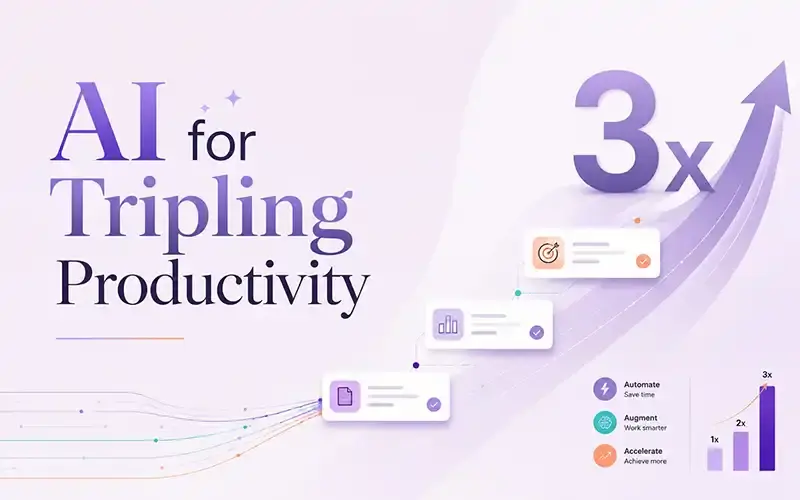
AI for Tripling Productivity
AI for End Users Plus is an intermediate-level lesson designed to deepen the skills of users who already understand the basics of artificial intelligence. This course focuses on applying advanced AI tools to real-world tasks, enhancing productivity, creativity, and efficiency in professional and personal contexts. Learners will explore features such as AI-powered content creation, smart assistants, task automation, and data-driven decision support. The course also covers responsible AI use, including ethical considerations, privacy concerns, and how to critically evaluate AI-generated content. Whether you're aiming to work smarter, streamline workflows, or better collaborate with AI systems, this lesson equips you with the tools and mindset needed to use AI confidently and effectively.
4.8
(0)
