 English
 Certificate of Cloud Security Knowledge (CCSK)
The Certificate of Cloud Security Knowledge (CCSK) Foundation Course (V5) provides a deep understanding of cloud security fundamentals and progressively advances through all 12 domains of the CSA Security Guidance. It incorporates key recommendations from the European Union Agency for Network & Information Security (ENISA) and offers an overview of the Cloud Controls Matrix (CCM). This course equips learners with essential knowledge to understand, assess, and implement effective cloud security practices across diverse environments.
- 4.8/5.0
- 2765 Enrolled
- Last updated Jun 16, 2026
Course Overview
- The CCSK Foundation
Course provides a comprehensive introduction to cloud security
and builds a deep understanding of the key principles required to secure cloud
environments. The course begins with the fundamental concepts of cloud
computing and gradually advances to more complex topics, covering all 16
domains of the Cloud Security Alliance (CSA)
Security Guidance.
- Throughout the course, participants will explore best practices and methodologies recommended by the European Union Agency for Network and Information Security (ENISA), ensuring alignment with global standards for cloud security and risk management. In addition, the course includes an in-depth overview of the Cloud Controls Matrix (CCM) — a powerful framework designed to assess the security posture of cloud service providers and guide organizations in implementing effective cloud governance and compliance strategies.
- By the end of the CCSK Foundation course, learners will have developed a strong understanding of how to identify, evaluate, and mitigate security risks in the cloud. They will also gain the knowledge needed to confidently address topics such as data protection, incident response, legal considerations, and cloud-specific threat analysis.
- This course serves as a valuable foundation for IT professionals, auditors, and security practitioners seeking to enhance their expertise in cloud security and prepare for the CCSK certification exam, recognized globally as a leading credential in cloud security competence.
Course Outlines
Domain 1: Cloud Computing
Concepts & Architecture
- This domain introduces the fundamental concepts of cloud computing, including service models (IaaS, PaaS, SaaS) and deployment models (public, private, hybrid, community). It also explores the essential characteristics defined by NIST, cloud reference architecture, and shared responsibility models, providing a solid foundation for understanding cloud environments.
- Domain 2: Cloud Governance and
Strategies
Focuses on developing governance frameworks and strategies for secure cloud adoption. It covers policy development, roles and responsibilities, accountability mechanisms, and how organizations can align cloud initiatives with business objectives and compliance requirements.
- Domain 3: Risk, Audit, and Compliance
Examines risk management principles and practices in cloud environments. It includes methods for identifying, assessing, and mitigating cloud-specific risks, as well as performing audits to ensure compliance with regulatory standards such as GDPR, ISO 27001, and SOC 2.
- Domain 4: Organization Management
Explores how cloud computing impacts organizational structure, culture, and operations. It discusses strategies for change management, defining roles (such as cloud service manager and cloud security officer), and integrating cloud governance into enterprise management systems.
- Domain 5: Identity and Access
Management (IAM)
Covers the principles and best practices for managing digital identities in the cloud. Topics include authentication, authorization, federated identity, Single Sign-On (SSO), and the use of identity providers to enforce least privilege and zero trust models.
- Domain 6: Security Monitoring
Provides an understanding of continuous monitoring, logging, and auditing in the cloud. It covers threat detection, intrusion monitoring, SIEM integration, and the use of automated tools to maintain visibility and detect anomalies in cloud environments.
- Domain 7: Infrastructure &
Networking
Focuses on securing cloud infrastructure components and networking architecture. It discusses virtual networks, firewalls, segmentation, secure connectivity, and the implementation of defense-in-depth strategies to protect cloud-based infrastructure.
- Domain 8: Cloud Workload Security
Covers how to secure workloads deployed in cloud environments, including virtual machines, containers, and serverless functions. It highlights configuration management, hardening, patching, and workload isolation to reduce attack surfaces.
- Domain 9: Data Security
Addresses the full lifecycle of data protection in the cloud — from data creation and storage to transmission and destruction. Topics include encryption, tokenization, data classification, key management, and strategies for ensuring data confidentiality, integrity, and availability.
- Domain 10: Application Security
Examines the security of applications built and hosted in the cloud. It includes secure development practices (DevSecOps), API security, code analysis, and protection against common vulnerabilities such as injection attacks and insecure configurations.
- Domain 11: Incident Response &
Resilience
Focuses on how to prepare for, detect, and respond to security incidents in the cloud. It also discusses business continuity planning (BCP), disaster recovery (DR), and strategies to ensure service resilience and minimize downtime.
- Domain 12: Related Technologies &
Strategies
Explores emerging technologies and trends that impact cloud security, such as artificial intelligence, blockchain, containerization, and serverless computing. It also includes best practices for integrating these technologies into a secure cloud strategy.
Course Objectives
Develop
a Strong Foundation in Cloud Security:
- Gain a comprehensive understanding of cloud computing concepts, architectures, and the unique security challenges associated with cloud environments.
- Prove
Your Efficiency in Cloud Security:
Learn how to demonstrate your proficiency in addressing key cloud security issues through methodologies and standards developed by leading cloud research organizations, including the Cloud Security Alliance (CSA).
- Complement
Other Professional Certifications:
Strengthen and expand your credentials by integrating CCSK knowledge with other globally recognized certifications such as CISA, CISSP, and CCSP, enhancing your overall cybersecurity expertise.
- Enhance
Technical Competence:
Acquire the skills to identify, implement, and manage effective cloud-specific security controls. Learn to demonstrate your technical knowledge and ability to apply these controls in real-world cloud environments.
- Bridge
the Cloud Skills Gap:
Improve your employability by gaining in-demand cloud security competencies. This certification fills a critical industry need for professionals who understand both cloud operations and security management.
- Master
Cloud Governance and Compliance:
Understand how to align cloud security practices with organizational governance frameworks, regulatory requirements, and compliance standards.
- Implement
Security Best Practices:
Learn to establish a baseline of cloud security best practices and apply them to various cloud service models (IaaS, PaaS, SaaS).
- Strengthen
Risk Management Capabilities:
Gain insights into cloud risk assessment, mitigation strategies, and incident response techniques tailored to cloud environments.
- Promote
Effective Communication Across Teams:
Develop the ability to collaborate effectively with IT, compliance, and business stakeholders to ensure a secure and compliant cloud adoption process.
- Prepare
for Advanced Cloud Security Roles:
Build the foundation needed to pursue advanced roles in cloud security architecture, auditing, risk management, and compliance.
Course Prerequisites
- To
get the most benefit from the Certificate of Cloud Security Knowledge (CCSK)
course, participants should have a solid foundational understanding of
networking and web technologies. This includes basic knowledge of network
protocols, firewalls, IP addressing, and internet architecture, as well as
familiarity with web applications, HTTP/HTTPS, and common security concepts.
- While no formal certification prerequisites are required, prior experience in information security, IT operations, or cloud computing environments will help learners grasp the advanced topics more effectively. Having a general awareness of cloud service models (IaaS, PaaS, SaaS) and deployment models (public, private, hybrid) is also recommended.
Course Schedule
| Date | Days Left | Training Location | |
|---|---|---|---|
Course Exam Info
- The
Certificate of Cloud Security Knowledge (CCSK) exam is a globally recognized
credential offered by the Cloud Security Alliance (CSA). It validates a candidate’s
understanding of key cloud security concepts, architecture, governance,
compliance, and operational best practices based on the CSA Security Guidance, ENISA
recommendations, and the Cloud Controls Matrix (CCM).
Exam Details:
- Exam Format: Online, open-book exam
- Number of Questions: 60 multiple-choice questions
- Duration: 90 minutes (1 hour and 30 minutes)
- Passing Score: 80% (48 correct answers out of 60)
- Language: English
- Exam Delivery: Administered online through the CSA platform
- Prerequisites: No formal prerequisites, but a basic understanding of cloud computing and security fundamentals is recommended
Exam Focus Areas:
The CCSK exam tests knowledge across the 12 domains of the CSA Security Guidance, including:
- Cloud Computing Concepts and Architecture
- Governance and Enterprise Risk Management
- Legal Issues, Contracts, and Electronic Discovery
- Compliance and Audit Management
- Information Governance
- Management Plane and Business Continuity
- Infrastructure Security
- Virtualization and Containers
- Incident Response
- Application Security
- Encryption and Key Management
- Identity, Entitlement, and Access Management
Key Points:
- The CCSK exam can be taken anytime, anywhere through the CSA online platform.
- Candidates receive their results immediately upon completion.
- Upon passing, you will receive a digital certificate from the Cloud Security Alliance, valid indefinitely.
- The certification is highly recommended for professionals seeking roles in cloud security, risk management, compliance, and governance.
Our Student Reviews
4.8
Excellent
Connor O’Reilly
Cloud security isn’t just a trend—it’s a necessity. This course gave me the knowledge to secure cloud environments effectively, from infrastructure to compliance. iExperts has been right in advocating for stronger cloud security awareness.
Benjamin Harris
Thank you very much for your clear and detailed training. You've got to keep my attention with all your examples, anecdotes, videos, voice intonation, humour and related topics during these 3 days. I have also learnt not just security new features, vulnerabilities and important topics for the CCSK test and Cloud, but also new ways to teach online and make trainees take part and follow the subject. You are a great communicator and remote presenter. I hope to have the opportunity to meet you in other virtual training or even directly in a security event when the situation lets us travel again.
Arian Khosravi
Instructor well organised, interested in helping students, well prepared and I learned greatly from Instructor . My overall feedback and rating is 10 out of 10. Thanks.
This course includes
- Duration24 h
- VendorCSA
- CategoryCloud Computing
- CertificateYes
Course Profile
Course Quiz
Test your knowledge with our course quiz! Answer a series of questions related to Certificate of Cloud Security Knowledge (CCSK).
Similar Courses
Certificate of Cloud Auditing Knowledge Course (CCAK)
The Certificate of Cloud Auditing Knowledge (CCAK) is the first credential available for industry professionals to demonstrate their expertise in the essential principles of auditing cloud computing systems. The CCAK credential and training program fills the gap in the market for technical education for cloud IT auditing. This credential leverages CSA’s cloud expertise and ISACA’s traditional audit expertise, combining our know-how and expertise to develop and deliver the best possible solution for cloud auditing education.
- 24 h 4.9 (2844)
You may also like
Check out most 🔥 courses in the market
Dora Lead Manager
The DORA (Digital Operational Resilience Act) Lead Manager course equips senior professionals with the skills and knowledge needed to oversee, manage, and ensure compliance with the DORA framework in financial institutions and related ICT service providers. This program covers operational resilience strategies, ICT risk management, incident handling, reporting requirements, and oversight of third-party providers, enabling participants to lead their organizations in meeting the EU’s regulatory expectations effectively.
4.9
(2000)
ISO 9001 Lead Implementer
The ISO 9001 Lead Implementer training course equips participants with the necessary knowledge and skills to support an organization in establishing, implementing, managing, and maintaining a Quality Management System (QMS) based on ISO 9001:2015. This course provides a practical methodology for the implementation process by applying best practices and aligning with international quality management standards. By the end of the course, participants will gain hands-on expertise in leading implementation projects, managing teams, and preparing organizations for certification audits.
4.8
(3000)
ISO 42001 AI lead implementer
The ISO/IEC 42001 Lead Auditor course equips professionals with the knowledge and skills to conduct and lead Artificial Intelligence Management System (AIMS) audits in compliance with ISO/IEC 42001. Participants will learn to apply internationally recognized audit principles, manage audit programs, and ensure AI governance aligns with ethical, legal, and organizational requirements. The course prepares attendees for certification as an ISO/IEC 42001 Lead Auditor, empowering them to assess AI systems for compliance, risk management, and continuous improvement.
4.9
(2000)
AI For End User
This course is a practical, tool-agnostic training program designed for professionals who want to leverage artificial intelligence in their daily work without needing a background in data science or programming. Participants will learn how AI interprets and processes human language, how to interact with AI tools effectively, and how to integrate AI into everyday tasks to enhance productivity, decision-making, and creativity.
4.9
(2457)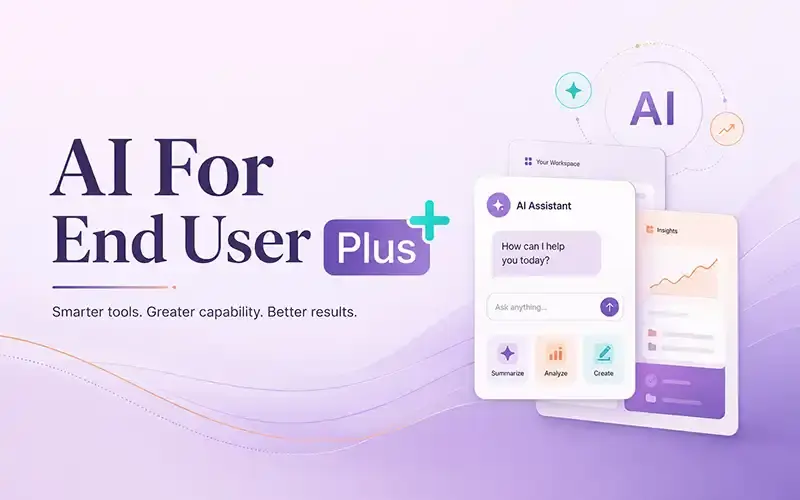
AI For End User Plus
This advanced lesson builds on foundational AI knowledge to help users unlock the full potential of AI tools in personal and professional settings. Learners will explore more powerful features of AI platforms, gain hands-on experience with smart assistants, content generators, and automation tools, and learn strategies for integrating AI into workflows. The course also emphasizes data awareness, ethical use, and decision-making with AI support—empowering users to use AI responsibly and effectively in real-world scenarios.
4.9
(1953)
