 English
 CompTIA Cloud +
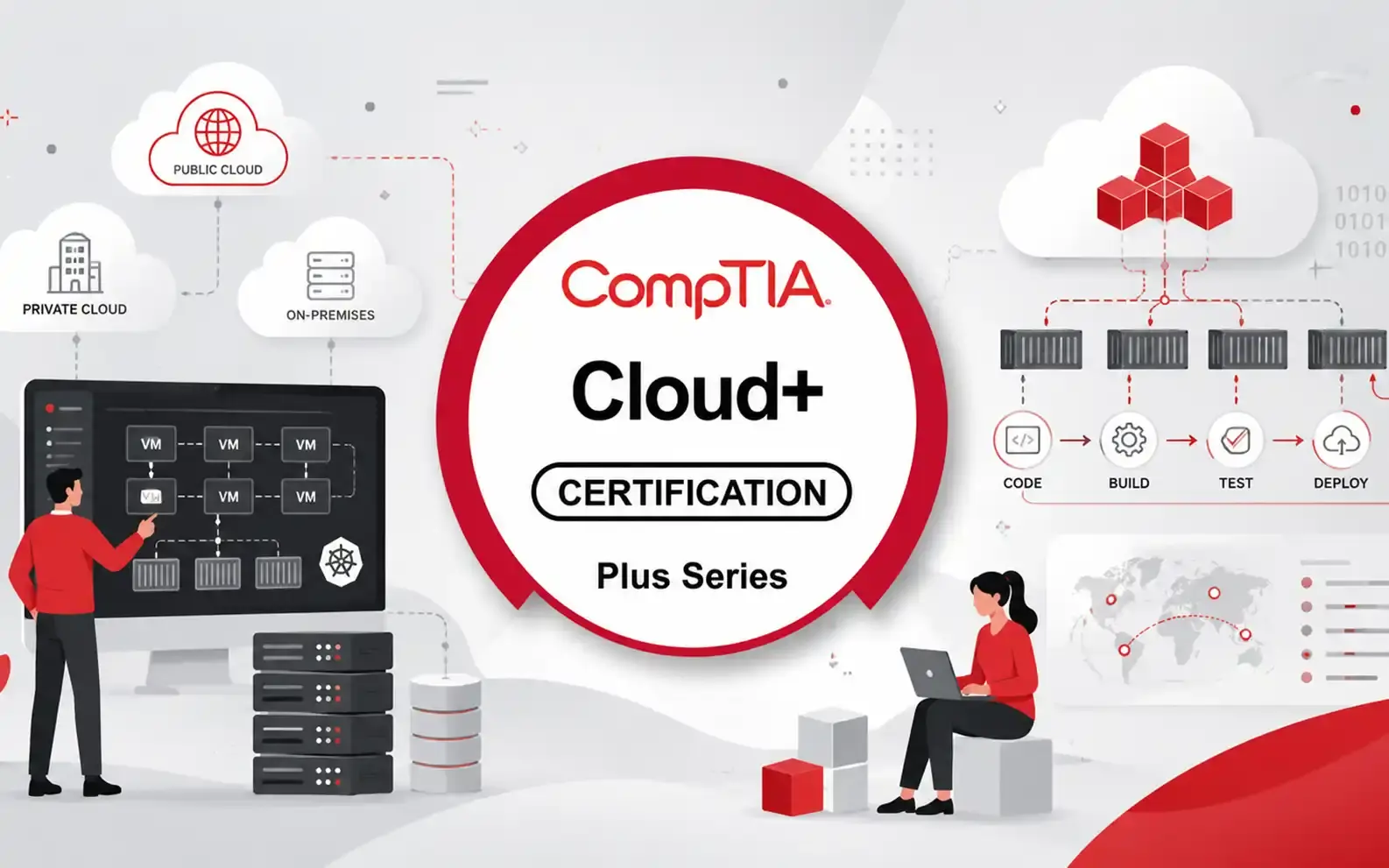
CompTIA Cloud+ validates the skills needed to deploy and automate secure cloud environments that support the high availability of business systems and data. It covers key concepts in cloud architecture, virtualization, and storage. The course also emphasizes cloud security, risk management, and compliance best practices. Participants learn how to manage and optimize cloud resources effectively. It provides practical knowledge for troubleshooting and resolving cloud infrastructure issues. The certification ensures readiness to support hybrid and multi-cloud environments. Overall, Cloud+ prepares professionals to maintain efficient, reliable, and secure cloud operations.
- 4.9/5.0
- 2976 Eingeschrieben
- Zuletzt aktualisiert Aug 28, 2026
Kursübersicht
- By obtaining the CompTIA Cloud+
certification, you not only jumpstart your cloud computing career, but you
also establish a strong and credible foothold in the rapidly evolving IT
industry. This certification equips you with the knowledge and skills necessary
to manage, secure, and optimize cloud environments efficiently. You will gain
hands-on expertise in deploying and automating secure cloud infrastructures
while ensuring high availability and performance of business systems and data.
- Beyond technical proficiency, Cloud+ trains you to proactively tackle complex cloud computing challenges, including troubleshooting, risk management, and capacity planning. You will also stay up to date with emerging cloud technologies, service models, and industry best practices, giving you the ability to evaluate, implement, and manage innovative solutions in both private and public cloud environments. By the end of this course, you will not only enhance your technical capabilities but also strengthen your strategic understanding of how cloud computing drives business growth and operational efficiency.
Kursübersicht
Preparing
to Deploy Cloud Solutions
- Understanding the requirements for cloud deployment in various environments.
- Evaluating business and technical needs for cloud adoption.
- Assessing existing infrastructure and determining migration strategies.
- Planning deployment timelines, resource allocation, and cost management.
- Selecting appropriate cloud models (public, private, hybrid, or multi-cloud).
Designing a Secure and Compliant Cloud Infrastructure
- Implementing security frameworks and compliance standards (e.g., ISO, NIST, GDPR).
- Designing network segmentation, firewall rules, and secure data flows.
- Planning for data privacy, regulatory compliance, and audit readiness.
- Integrating security controls into cloud architecture from the design phase.
Designing and Implementing a Secure Cloud Environment
- Deploying secure virtual machines, containers, and serverless functions.
- Applying encryption, key management, and data protection mechanisms.
- Configuring monitoring, logging, and alerting systems for security incidents.
- Enforcing security policies for cloud-native services and applications.
Planning Identity and Access Management for Cloud Deployments
- Designing user authentication and authorization strategies.
- Implementing single sign-on (SSO), multi-factor authentication (MFA), and role-based access control (RBAC).
- Managing identities across hybrid and multi-cloud environments.
- Auditing access controls and ensuring least-privilege principles are applied.
Determining CPU and Memory Sizing for Cloud Deployments
- Evaluating workload requirements for compute and memory resources.
- Selecting appropriate virtual machine types and instance sizes.
- Optimizing performance while minimizing cost and resource waste.
- Monitoring and adjusting resources dynamically based on demand.
Analysing Cloud Systems for Performance
- Implementing performance monitoring tools and techniques.
- Identifying bottlenecks and optimizing network, storage, and compute resources.
- Conducting capacity planning and trend analysis for scaling decisions.
- Using metrics and KPIs to ensure high availability and reliability.
Maintaining Cloud Systems
- Applying updates, patches, and upgrades to cloud services and applications.
- Performing regular backups and implementing disaster recovery strategies.
- Managing storage, networking, and compute resources efficiently.
- Ensuring compliance with organizational and regulatory requirements during maintenance.
Troubleshooting Security Issues
- Identifying, diagnosing, and resolving cloud security incidents.
- Analyzing logs, alerts, and vulnerability reports for potential threats.
- Implementing mitigation strategies and security patches promptly.
- Developing a proactive approach to detect and prevent future security breaches.
Kursziele
By
the end of this course, you will be able to:
- Understand cloud architecture and design: Gain in-depth knowledge of cloud computing concepts, architectures, and deployment models. Learn how to analyze business requirements and design secure, scalable, and efficient cloud solutions tailored to organizational needs.
- Deploy cloud services and solutions: Acquire practical skills to implement cloud infrastructure and services. This includes provisioning virtual machines, configuring storage solutions, setting up networking components, and deploying applications in a cloud environment using industry best practices.
- Maintain, secure, and optimize a cloud environment: Learn how to manage and maintain cloud resources to ensure high availability, performance, and cost-efficiency. Understand cloud security principles, including identity and access management, data protection, and compliance considerations, while applying optimization techniques to maximize resource utilization.
- Troubleshoot common cloud management issues: Develop the ability to identify and resolve issues related to cloud infrastructure, connectivity, performance, and service availability. Learn systematic approaches to diagnose problems and implement effective solutions in complex cloud environments.
- Prepare for the CompTIA Cloud+ certification exam: Gain the knowledge, skills, and practical experience necessary to confidently pass the CompTIA Cloud+ exam. Understand exam objectives, question types, and best practices for applying your skills in real-world scenarios.
- Support business objectives through cloud solutions: Understand how cloud technologies impact business operations, costs, and strategic goals. Learn to align cloud solutions with organizational objectives, ensuring that deployments provide measurable business value.
Kursvoraussetzungen
- Students should have a
foundational understanding of IT concepts and practical experience in working
with server and network environments. They should also be familiar with major
hypervisor technologies used for server virtualization, including platforms
such as VMware, Hyper-V, and KVM. In addition, students should possess basic
knowledge of cloud computing concepts, including the primary cloud service
models (IaaS, PaaS, SaaS) and common cloud deployment models (public, private,
hybrid, and community clouds). Practical exposure to managing servers, storage,
and networking components, as well as basic troubleshooting skills, will be
highly beneficial. This prior knowledge ensures that students can effectively
engage with the course content and gain hands-on experience with cloud
infrastructure design, deployment, and management.
Kursplan
| Datum | Tage übrig | Schulungsort | |
|---|---|---|---|
Keine Termine verfügbar | |||
Kursprüfungsinformationen
- CompTIA
Cloud+ is an intermediate-level certification designed for IT professionals
seeking to validate their skills in deploying, managing, and securing cloud
environments within broader IT infrastructures. It is a vendor-neutral
credential that covers a wide spectrum of cloud technologies, including
private, public, and hybrid cloud deployments. The certification emphasizes
understanding cloud architecture and design, deploying cloud solutions,
managing cloud operations, ensuring security, and troubleshooting issues in
multi-vendor environments. Achieving Cloud+ demonstrates the professional’s
ability to implement and maintain reliable, secure cloud solutions that uphold
high availability and operational efficiency for business-critical services.
Cloud+ also equips candidates to understand how cloud computing integrates with
existing IT systems, making it suitable for roles like cloud engineer, systems
administrator, network engineer, and IT operations specialist.
- Eligibility
/ Prerequisites:
While there is no strict prerequisite for attempting the Cloud+ exam, CompTIA strongly recommends candidates have 2–3 years of hands-on experience in IT systems administration or networking. Familiarity with virtualization, storage, and cloud technologies is highly advised. Candidates who have earned CompTIA Network+ and/or CompTIA Server+ certifications (or possess equivalent knowledge) will have a strong foundation to build on, as Cloud+ expands on networking, virtualization, storage, and security concepts within cloud contexts. The certification is ideal for IT professionals looking to move into cloud-focused roles or enhance their existing cloud expertise.
- Exam
Structure:
The Cloud+ certification is assessed through one comprehensive exam (current code: CV0-003) comprising up to 90 questions, a combination of multiple-choice and performance-based items that simulate real-world cloud scenarios. Candidates have 90 minutes to complete the exam, and the passing score is 750 on a scale of 100–900.
The exam tests practical knowledge and skills in several core domains:
- Cloud Architecture & Design: 13% – Evaluating and designing cloud environments, understanding cloud models (IaaS, PaaS, SaaS), and selecting appropriate technologies.
- Cloud Security: 20% – Implementing security controls, managing compliance, and securing data and workloads in cloud environments.
- Deployment: 23% – Provisioning cloud resources, integrating cloud with on-premises systems, and configuring services for optimal performance.
- Operations / Support: 22% – Managing cloud operations, monitoring performance, and ensuring system availability.
- Troubleshooting: 22% – Diagnosing and resolving issues in cloud systems, including network, storage, and application-related problems.
- Performance-based questions require candidates to perform tasks or solve problems in simulated cloud environments, testing their ability to apply knowledge in practical scenarios rather than just theoretical concepts.
Renewal
/ Recertification:
The Cloud+ certification is valid for three years from the date of
achievement. Renewal falls under CompTIA’s Continuing Education (CE) program,
which requires earning 50 CEUs within the three-year period
through professional development activities. These activities may include:
- Completing higher-level CompTIA certifications or training
- Participating in approved industry training or courses
- Contributing to the IT community through publications, presentations, or teaching
- If a professional does not earn the required CEUs or retake the exam, the certification will expire, necessitating re-certification to maintain valid credentials. Maintaining Cloud+ ensures IT professionals stay current with evolving cloud technologies, practices, and security standards, keeping them competitive in the rapidly changing cloud computing landscape.
Bewertungen unserer Kunden
4.9
(*)(*)(*)(*)(*)
Excellent
(*)(*)(*)(*)(*)
(*)(*)(*)(*)( )
( )( )( )( )( )
( )( )( )( )( )
( )( )( )( )( )
Michael Turner
I always thought cyber threats were a problem for big companies—until I saw how easily small businesses get targeted too. This course made security real for me. iExperts constantly warns about this, and now I understand why.
(*)(*)(*)(*)(*)
Arian Khosravi
nstructor well organised, interested in helping students, well prepared and I learned greatly from Instructor . My overall feedback and rating is 10 out of 10. Thanks.
(*)(*)(*)(*)(*)
Dieser Kurs beinhaltet
- Dauer40 Std.
- AnbieterCompTIA
- KategorieCyber Security
- ZertifikatJa
Kursprofil
Ähnliche Kurse
Security + 701
CompTIA Security+ is a globally recognized certification that validates the foundational skills required for IT security roles. It confirms your ability to perform core security functions and apply best practices across various systems. The course covers essential topics such as threat management, risk mitigation, and incident response. It equips you with knowledge of network security, cryptography, identity management, and access control. Security+ 701 ensures you understand how to protect devices, data, and infrastructure from modern cyber threats. The certification serves as a stepping stone for advanced security certifications and career growth in cybersecurity. By completing this course, you demonstrate to employers that you have the practical skills and knowledge to secure IT environments effectively.
- 40 Std. 4.8 (2933)
Pentest +
The CompTIA PenTest+ certification course will walk you through the process of performing a pentest. You'll also become familiar with many popular tools and scripting languages. Whether you're interested in becoming a pentester or simply curious about the profession, this course is for you. Not only will this course prepare you for the certification exam, but it will also arm you with the skills necessary for entering into the mysterious realm of pentesting.
- 40 Std. 4.9 (2873)
Cyber Security Analyst (CySA +)
CompTIA Cybersecurity Analyst (CySA+) is a globally recognized certification designed for cybersecurity professionals responsible for protecting and defending organizational networks. The certification focuses on threat detection, prevention, and response through continuous security monitoring. It validates the skills needed to analyze data, identify vulnerabilities, and implement effective security solutions to safeguard systems and applications against modern cyber threats. This course prepares learners to apply behavioral analytics to networks and devices to prevent, detect, and combat cybersecurity threats through real-time monitoring and incident response techniques. It bridges the gap between the foundational security knowledge of Security+ and the advanced expertise of CompTIA PenTest+.
- 40 Std. 4.7 (2633)
Advanced Security Practitioner (CASP +)
The CompTIA Advanced Security Practitioner (CASP+) certification focuses on the technical knowledge and skills necessary to design, engineer, integrate, and implement secure solutions in complex environments. It emphasizes supporting a resilient enterprise while addressing governance, risk, and compliance requirements. This exam does not use a scaled score system and is evaluated on a pass/fail basis.
- 40 Std. 4.8 (2364)
CompTIA A +
The CompTIA A+ Core Series requires candidates to pass two exams: Core 1 (220-1101) and Core 2 (220-1102). These exams cover the latest content and emphasize the technologies and skills IT professionals need to effectively support a hybrid workforce. This certification validates foundational IT skills across various areas such as hardware, networking, mobile devices, operating systems, troubleshooting, and security. It prepares learners to manage and maintain modern computing environments, ensuring smooth technical support in both on-site and remote work settings. Earning the CompTIA A+ certification demonstrates that you have the practical knowledge and problem-solving abilities required for entry-level IT support roles, making it a globally recognized starting point for a successful career in information technology.
- 40 Std. 4.8 (2354)
Das könnte Ihnen auch gefallen
Entdecken Sie die beliebtesten 🔥 Kurse auf dem Markt
Certified Information Security Manager (CISM)
The Certified Information Security Manager (CISM) course provides essential expertise in designing, managing, and governing enterprise information security programs. It equips you to align security strategies with business objectives, conduct risk assessments, and implement effective controls. You will learn to manage incident response, evaluate vulnerabilities, and ensure organizational compliance. The program also builds leadership and communication skills to promote a strong security culture. Earning CISM validates your ability to lead security initiatives that protect assets and support business success.
4.8
(2135)
Certified in the Governance of Enterprise IT (CGEIT)
The Certified in the Governance of Enterprise IT (CGEIT) course equips experienced professionals to lead and optimize enterprise IT governance. It focuses on aligning IT strategies with business objectives, maximizing value delivery, and ensuring effective risk and resource management. Participants gain a strong understanding of governance frameworks, strategic alignment, and accountability structures. The course also covers key components such as policies, processes, SLAs/OLAs, and data integrity. Graduates will be able to design, implement, and monitor robust IT governance systems that enhance organizational performance.
4.8
(1743)
Certified Information Systems Auditor (CISA)
The Certified Information Systems Auditor (CISA) course equips professionals to audit, control, and secure IT systems effectively. Participants learn to assess IT governance, evaluate system performance, and manage risks and compliance. The course covers data protection, internal controls, and business continuity planning. It prepares attendees for the CISA exam and roles such as IT auditor, risk manager, and compliance officer. Certification validates expertise in IT governance and adherence to global standards.
5
(2398)
Dora Lead Manager
The DORA (Digital Operational Resilience Act) Lead Manager course equips senior professionals with the skills and knowledge needed to oversee, manage, and ensure compliance with the DORA framework in financial institutions and related ICT service providers. This program covers operational resilience strategies, ICT risk management, incident handling, reporting requirements, and oversight of third-party providers, enabling participants to lead their organizations in meeting the EU’s regulatory expectations effectively.
4.9
(2000)
ISO 9001 Lead Implementer
The ISO 9001 Lead Implementer training course equips participants with the necessary knowledge and skills to support an organization in establishing, implementing, managing, and maintaining a Quality Management System (QMS) based on ISO 9001:2015. This course provides a practical methodology for the implementation process by applying best practices and aligning with international quality management standards. By the end of the course, participants will gain hands-on expertise in leading implementation projects, managing teams, and preparing organizations for certification audits.
4.8
(3000)