 English
 Cyber Security Analyst (CySA +)
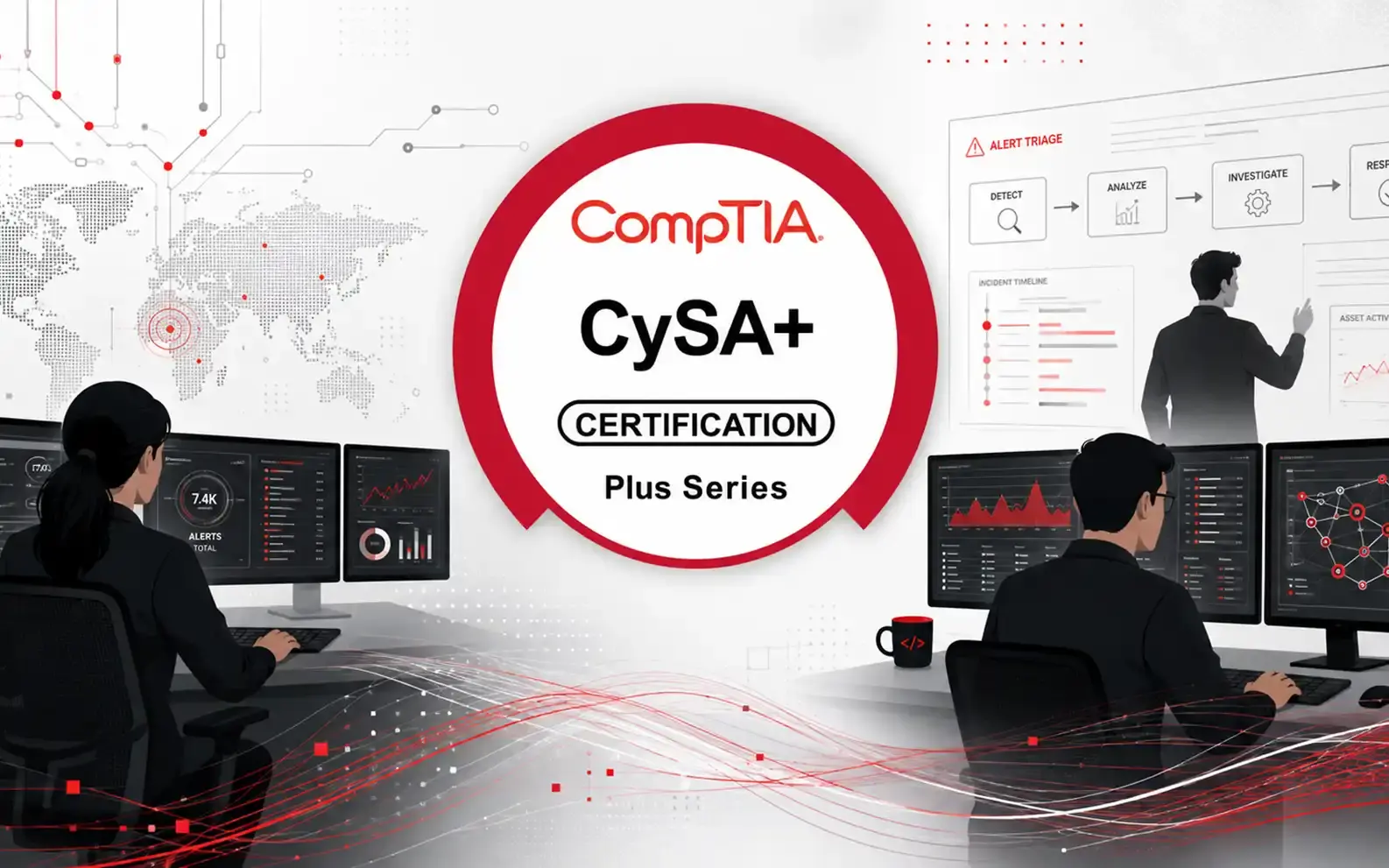
CompTIA Cybersecurity Analyst (CySA+) is a globally recognized certification designed for cybersecurity professionals responsible for protecting and defending organizational networks. The certification focuses on threat detection, prevention, and response through continuous security monitoring. It validates the skills needed to analyze data, identify vulnerabilities, and implement effective security solutions to safeguard systems and applications against modern cyber threats. This course prepares learners to apply behavioral analytics to networks and devices to prevent, detect, and combat cybersecurity threats through real-time monitoring and incident response techniques. It bridges the gap between the foundational security knowledge of Security+ and the advanced expertise of CompTIA PenTest+.
- 4.7/5.0
- 2633 Eingeschrieben
- Zuletzt aktualisiert Aug 28, 2026
Kursübersicht
- The CompTIA Cybersecurity Analyst (CySA+) certification is designed for cybersecurity professionals responsible for defending organizations against cybersecurity threats through continuous monitoring, analysis, and proactive response. This course emphasizes the application of behavioral analytics to networks and devices, helping identify and combat malware, advanced persistent threats (APTs), and other vulnerabilities.
- CySA+ focuses on enhancing the learner’s ability to detect, prevent, and respond to security incidents using the latest tools, techniques, and best practices in the industry. It bridges the gap between knowledge-based and hands-on skills, ensuring that candidates can effectively manage real-world cybersecurity challenges.
- Throughout the course, participants will gain a deep understanding of threat intelligence, vulnerability management, incident response, and security architecture. The certification validates intermediate-level cybersecurity skills essential for roles such as security analysts, threat hunters, and SOC (Security Operations Center) professionals.
- By the end of this course, learners will be prepared to proactively defend organizational networks, perform detailed security assessments, and contribute to an organization’s overall cyber resilience.
Kursübersicht
Develop Skills in Mobile Devices and Virtualization
- Gain hands-on experience with mobile device management (MDM) tools and policies.
- Understand how virtualization supports secure network environments and incident response.
- Explore cloud-based virtualization technologies, hypervisors, and virtual machines.
- Learn to identify and mitigate security vulnerabilities within mobile and virtualized systems.
Understand Hardware Components and Their Functions
- Study the architecture and components of computer systems and network hardware.
- Learn how different hardware elements interact within a secure IT infrastructure.
- Identify potential hardware-related vulnerabilities and methods to secure them.
- Understand hardware forensics and its role in incident response.
Proficiently Manage and Troubleshoot Various Operating Systems
- Gain in-depth knowledge of Windows, Linux, and macOS operating systems.
- Learn to implement system hardening techniques to enhance security.
- Perform system monitoring, log analysis, and troubleshooting for security incidents.
- Understand patch management, user privileges, and access control measures.
Learn Essential Networking Concepts and Protocols
- Explore networking fundamentals such as IP addressing, routing, and switching.
- Understand key protocols like TCP/IP, DNS, DHCP, and VPNs in a cybersecurity context.
- Analyze network traffic and identify abnormal or malicious behavior using monitoring tools.
- Gain skills in configuring secure network devices and defending against network-based attacks.
Master Security Principles and Best Practices
- Understand the core principles of information security: confidentiality, integrity, and availability (CIA triad).
- Learn about threat intelligence, vulnerability management, and risk mitigation strategies.
- Explore identity and access management (IAM), authentication methods, and encryption technologies.
- Apply cybersecurity frameworks and compliance standards to real-world scenarios.
- Practice developing and implementing effective incident response and recovery plans.
Kursziele
- The CompTIA Cybersecurity Analyst
(CySA+) certification verifies that successful candidates have the advanced
knowledge and practical skills necessary to protect and defend information
systems. It focuses on the ability to leverage intelligence and threat
detection techniques, analyze and interpret data, identify and address security
vulnerabilities, and suggest proactive preventative measures.
- Holders of this certification are equipped to effectively monitor and secure network environments, respond to security incidents, and perform comprehensive threat analysis. The certification also validates the candidate’s ability to apply behavioral analytics to networks and devices to prevent, detect, and combat cybersecurity threats.
- Additionally, candidates learn how to manage vulnerability management activities, assess the results of security monitoring, and use digital forensics techniques for incident response and recovery. By mastering these objectives, professionals become capable of strengthening the overall security posture of an organization through continuous monitoring, proactive defense strategies, and effective communication of security findings and recommendations.
Kursvoraussetzungen
Before
enrolling in the CompTIA Cybersecurity Analyst (CySA+)
course, it is recommended that candidates have a solid foundation in IT
security and networking concepts. While there are no mandatory prerequisites,
the following background and experience will help ensure success in the
program:
- CompTIA
Security+ Certification or Equivalent Knowledge
Candidates should have completed the CompTIA Security+ certification or possess equivalent knowledge in network and system security fundamentals.
- Experience
in IT Administration or Security Operations
A minimum of 3–4 years of hands-on experience working in information security, network administration, or a related IT field is highly beneficial.
- Understanding
of Network Concepts
Familiarity with common networking protocols, devices, and topologies, as well as basic troubleshooting skills, will help in understanding threat detection and response techniques.
- Knowledge
of Operating Systems
Competence in managing and securing both Windows and Linux operating systems, including system configuration, monitoring, and access control, is recommended.
- Basic
Understanding of Cyber Threats and Vulnerabilities
Awareness of different types of cyberattacks, threat actors, and common vulnerabilities helps in effectively analyzing and mitigating security incidents.
- Analytical
and Problem-Solving Skills
Since CySA+ focuses on identifying, analyzing, and responding to security threats, having strong analytical and critical-thinking skills is essential.
- Familiarity
with Security Tools and Technologies
Prior exposure to security information and event management (SIEM) systems, intrusion detection/prevention systems (IDS/IPS), and endpoint security tools will provide a valuable advantage.
- By meeting these recommended prerequisites, learners will be well-prepared to engage with the CySA+ curriculum and develop advanced cybersecurity analysis and threat management skills.
Kursplan
| Datum | Tage übrig | Schulungsort | |
|---|---|---|---|
Keine Termine verfügbar | |||
Kursprüfungsinformationen
- The
CompTIA
Cybersecurity Analyst (CySA+) certification exam evaluates a
candidate’s ability to apply behavioral analytics and proactive defense
techniques to identify and combat cybersecurity threats. It validates
intermediate-level skills necessary to perform continuous monitoring, detect
anomalies, analyze data, and effectively respond to security incidents within
enterprise environments.
- Exam Code: CS0-003 (current version)
- Exam Format and Structure:
- Number of Questions: Up to 85 questions per exam session
- Question Types: A combination of multiple-choice, multiple-response, drag-and-drop, and performance-based questions (PBQs) designed to simulate real-world cybersecurity tasks.
- Duration: 165 minutes (2 hours and 45 minutes)
- Passing Score: 750 (on a scale of 100–900)
- Exam Languages: Available in English and other major languages depending on region and testing center.
- Delivery Method: The exam can be taken online (remote proctored) or in person at an authorized Pearson VUE testing center.
Domains
Covered:
The CySA+ exam objectives are divided into several key domains that assess the
candidate’s ability to secure an organization’s IT environment:
- Threat and Vulnerability Management – Identifying, analyzing, and managing security vulnerabilities and threats using industry-standard tools and techniques.
- Security Operations and Monitoring – Performing continuous monitoring, log analysis, and threat detection to recognize abnormal activity and potential security incidents.
- Incident Response and Management – Executing incident response procedures, containment, eradication, and recovery actions while documenting findings.
- Compliance and Assessment – Understanding risk management, frameworks, and regulatory compliance requirements to ensure secure business operations.
- Tools and Technologies – Applying practical knowledge of cybersecurity tools used in SIEMs, endpoint protection, firewalls, and network defense.
- Eligibility
and Prerequisites:
While there are no strict prerequisites, CompTIA recommends the following:
- Certifications: CompTIA Network+ and Security+ (or equivalent foundational knowledge).
- Experience: 3–4 years of practical, hands-on
experience in cybersecurity, particularly in roles such as Security Operations
Center (SOC) analyst, threat analyst, or incident responder.
CySA+ is best suited for individuals looking to advance from entry-level positions to intermediate cybersecurity roles and serves as a bridge between Security+ and CASP+ (CompTIA Advanced Security Practitioner) certifications.
Renewal and Recertification:
- Validity Period: 3 years from the date of certification.
- Renewal Options: Certification holders must earn 60 Continuing Education Units (CEUs) or achieve a higher-level certification within the three-year renewal cycle.
- CompTIA Continuing Education (CE) Program: Renewing the CySA+ also automatically renews lower-tier certifications such as Security+ and Network+.
- Career
Impact:
Earning CySA+ demonstrates a professional’s ability to proactively defend networks, conduct threat intelligence, and respond to complex security events, making it a highly respected credential for cybersecurity analysts, SOC professionals, and threat hunters in both government and private sectors.
Bewertungen unserer Kunden
4.7
(*)(*)(*)(*)(*)
Excellent
(*)(*)(*)(*)(*)
(*)(*)(*)(*)( )
( )( )( )( )( )
( )( )( )( )( )
( )( )( )( )( )
Louis Bernard
Security analysis is more than monitoring logs; it’s about understanding patterns, behaviors, and threats before they escalate. This certification brings clarity to that process, and I see why iExperts recommends it for anyone in cybersecurity.
(*)(*)(*)(*)(*)
Luca Ricci
Thanks for five-day training on fundamentals of cybersecurity which you’ve delivered virtually between October 23-27. I would like to thank you for using all the knowledge you have as complimentary to the course material and for trying to include everybody into discussion during the week. Training helped to close gaps about security concepts and made a good foundation for further trainings and expertise. Thanks,
(*)(*)(*)(*)(*)
Dieser Kurs beinhaltet
- Dauer40 Std.
- AnbieterCompTIA
- KategorieCyber Security
- ZertifikatJa
Kursprofil
Kursquiz
Testen Sie Ihr Wissen mit unserem Kursquiz! Beantworten Sie eine Reihe von Fragen zu Cyber Security Analyst (CySA +).
Ähnliche Kurse
Security + 701
CompTIA Security+ is a globally recognized certification that validates the foundational skills required for IT security roles. It confirms your ability to perform core security functions and apply best practices across various systems. The course covers essential topics such as threat management, risk mitigation, and incident response. It equips you with knowledge of network security, cryptography, identity management, and access control. Security+ 701 ensures you understand how to protect devices, data, and infrastructure from modern cyber threats. The certification serves as a stepping stone for advanced security certifications and career growth in cybersecurity. By completing this course, you demonstrate to employers that you have the practical skills and knowledge to secure IT environments effectively.
- 40 Std. 4.8 (2933)
Pentest +
The CompTIA PenTest+ certification course will walk you through the process of performing a pentest. You'll also become familiar with many popular tools and scripting languages. Whether you're interested in becoming a pentester or simply curious about the profession, this course is for you. Not only will this course prepare you for the certification exam, but it will also arm you with the skills necessary for entering into the mysterious realm of pentesting.
- 40 Std. 4.9 (2873)
Advanced Security Practitioner (CASP +)
The CompTIA Advanced Security Practitioner (CASP+) certification focuses on the technical knowledge and skills necessary to design, engineer, integrate, and implement secure solutions in complex environments. It emphasizes supporting a resilient enterprise while addressing governance, risk, and compliance requirements. This exam does not use a scaled score system and is evaluated on a pass/fail basis.
- 40 Std. 4.8 (2364)
CompTIA A +
The CompTIA A+ Core Series requires candidates to pass two exams: Core 1 (220-1101) and Core 2 (220-1102). These exams cover the latest content and emphasize the technologies and skills IT professionals need to effectively support a hybrid workforce. This certification validates foundational IT skills across various areas such as hardware, networking, mobile devices, operating systems, troubleshooting, and security. It prepares learners to manage and maintain modern computing environments, ensuring smooth technical support in both on-site and remote work settings. Earning the CompTIA A+ certification demonstrates that you have the practical knowledge and problem-solving abilities required for entry-level IT support roles, making it a globally recognized starting point for a successful career in information technology.
- 40 Std. 4.8 (2354)
CompTIA Cloud +
CompTIA Cloud+ validates the skills needed to deploy and automate secure cloud environments that support the high availability of business systems and data. It covers key concepts in cloud architecture, virtualization, and storage. The course also emphasizes cloud security, risk management, and compliance best practices. Participants learn how to manage and optimize cloud resources effectively. It provides practical knowledge for troubleshooting and resolving cloud infrastructure issues. The certification ensures readiness to support hybrid and multi-cloud environments. Overall, Cloud+ prepares professionals to maintain efficient, reliable, and secure cloud operations.
- 40 Std. 4.9 (2976)
Das könnte Ihnen auch gefallen
Entdecken Sie die beliebtesten 🔥 Kurse auf dem Markt
Certified Information Security Manager (CISM)
The Certified Information Security Manager (CISM) course provides essential expertise in designing, managing, and governing enterprise information security programs. It equips you to align security strategies with business objectives, conduct risk assessments, and implement effective controls. You will learn to manage incident response, evaluate vulnerabilities, and ensure organizational compliance. The program also builds leadership and communication skills to promote a strong security culture. Earning CISM validates your ability to lead security initiatives that protect assets and support business success.
4.8
(2135)
Certified in the Governance of Enterprise IT (CGEIT)
The Certified in the Governance of Enterprise IT (CGEIT) course equips experienced professionals to lead and optimize enterprise IT governance. It focuses on aligning IT strategies with business objectives, maximizing value delivery, and ensuring effective risk and resource management. Participants gain a strong understanding of governance frameworks, strategic alignment, and accountability structures. The course also covers key components such as policies, processes, SLAs/OLAs, and data integrity. Graduates will be able to design, implement, and monitor robust IT governance systems that enhance organizational performance.
4.8
(1743)
Certified Information Systems Auditor (CISA)
The Certified Information Systems Auditor (CISA) course equips professionals to audit, control, and secure IT systems effectively. Participants learn to assess IT governance, evaluate system performance, and manage risks and compliance. The course covers data protection, internal controls, and business continuity planning. It prepares attendees for the CISA exam and roles such as IT auditor, risk manager, and compliance officer. Certification validates expertise in IT governance and adherence to global standards.
5
(2398)
Dora Lead Manager
The DORA (Digital Operational Resilience Act) Lead Manager course equips senior professionals with the skills and knowledge needed to oversee, manage, and ensure compliance with the DORA framework in financial institutions and related ICT service providers. This program covers operational resilience strategies, ICT risk management, incident handling, reporting requirements, and oversight of third-party providers, enabling participants to lead their organizations in meeting the EU’s regulatory expectations effectively.
4.9
(2000)
ISO 9001 Lead Implementer
The ISO 9001 Lead Implementer training course equips participants with the necessary knowledge and skills to support an organization in establishing, implementing, managing, and maintaining a Quality Management System (QMS) based on ISO 9001:2015. This course provides a practical methodology for the implementation process by applying best practices and aligning with international quality management standards. By the end of the course, participants will gain hands-on expertise in leading implementation projects, managing teams, and preparing organizations for certification audits.
4.8
(3000)