 English
 CompTIA DataSys +
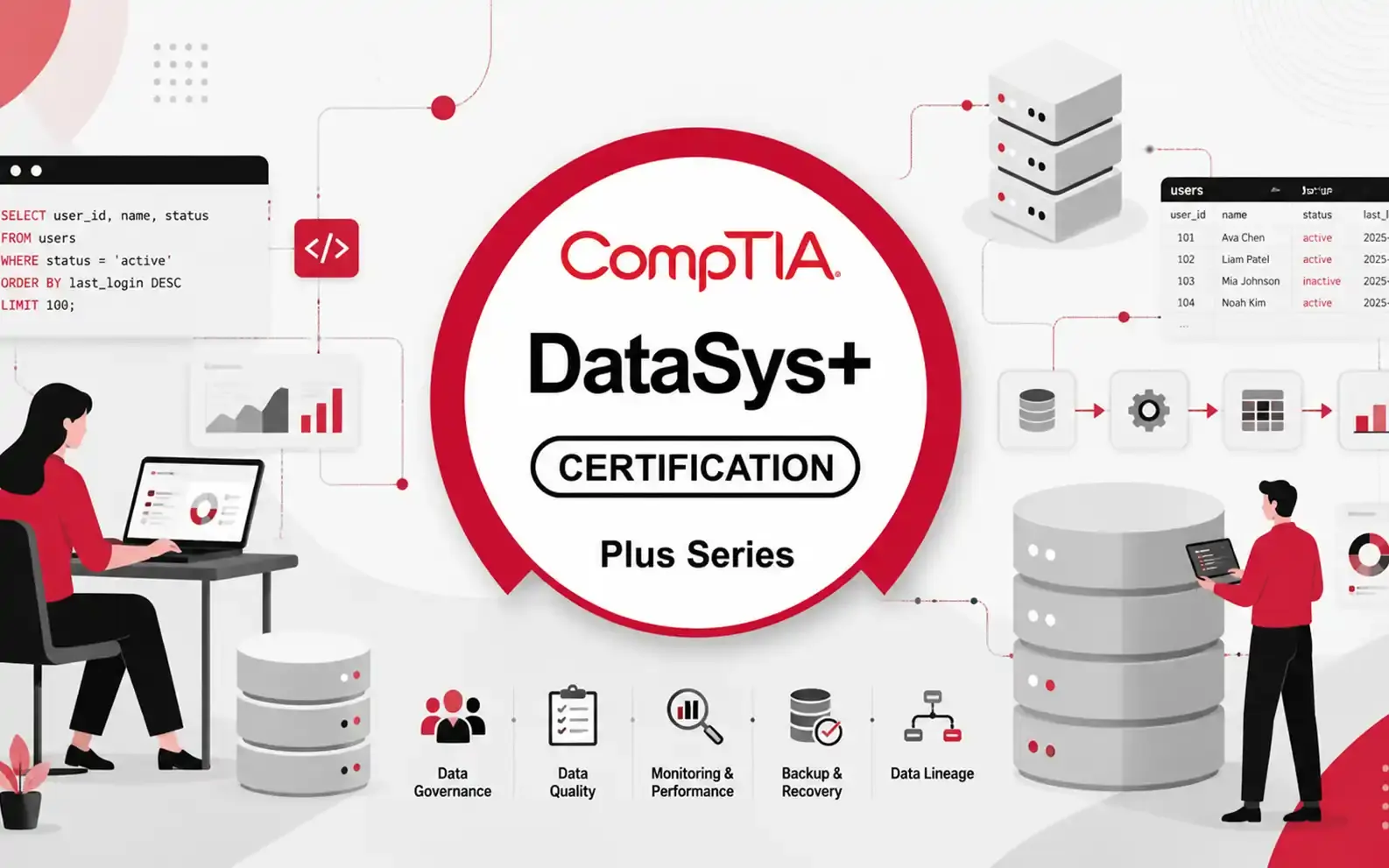
The CompTIA DataSys+ exam sets a unified standard of skills for the successful management and securing of data assets. It covers what database administrators need to deploy, manage, and maintain high-availability systems. The exam also emphasizes employing the fundamentals of scripting and programming in a relational database environment. Candidates will learn to apply security best practices and ensure business continuity. It includes understanding backup and recovery strategies, performance tuning, and monitoring of database systems. Additionally, it focuses on compliance with industry regulations and effective data governance. By mastering these skills, IT professionals can confidently support enterprise data operations and optimize database performance.
- 4.8/5.0
- 1938 Ingeschreven
- Laatst bijgewerkt Aug 28, 2026
Cursusoverzicht
- CompTIA
DataSys+ Certification Training offers an in-depth, comprehensive program
designed to fully prepare you for the DataSys+ certification exam. This course
goes beyond basic knowledge, providing a vendor-neutral understanding of the
fundamental principles, tools, and practices used in managing, securing, and
analyzing data throughout its lifecycle.
- Throughout the training, you will gain expertise in data collection, storage, processing, and analysis, as well as in ensuring data integrity, security, and compliance with industry standards. The course emphasizes hands-on experience through practical labs and real-world scenarios, allowing you to apply what you learn in a controlled environment.
- By the end of the program, you will be able to implement effective data management strategies, troubleshoot common issues, optimize database performance, and ensure data availability for high-demand business environments. The training also covers essential scripting and programming concepts within relational database environments, preparing you to support automated workflows and enhance operational efficiency.
- Whether you are a database administrator, data analyst, or IT professional seeking to validate your data management skills, this course provides the knowledge, practical skills, and confidence needed to excel in today’s data-driven workplaces.
Cursusoverzicht
Understanding
Database Types and Structures
- Explore various types of databases including relational, NoSQL, key-value, document, and graph databases.
- Understand how database structures affect data storage, indexing, querying, and performance.
- Compare normalized vs. denormalized database designs and their use cases.
- Examine common database models and their real-world applications.
Explaining the Impact of Programming on Database Operations
- Understand how different programming languages interact with databases through APIs and query languages such as SQL and NoSQL queries.
- Learn about stored procedures, triggers, and functions, and how they optimize database operations.
- Explore the role of scripting and automation in maintaining data integrity and efficiency.
- Study common programming patterns for database management and performance tuning.
Understanding Governance and Regulatory Compliance
- Learn the principles of data governance, including ownership, stewardship, and accountability.
- Explore key regulatory standards such as GDPR, HIPAA, SOX, and PCI-DSS.
- Understand the importance of compliance audits, reporting, and documentation.
- Identify policies and procedures to ensure databases meet legal and ethical requirements.
Securing the Database and Server
- Explore techniques to protect database systems from unauthorized access and vulnerabilities.
- Study encryption methods for data at rest and in transit.
- Learn about access control models, authentication, and role-based permissions.
- Understand database monitoring, intrusion detection, and vulnerability assessment best practices.
Classifying Types of Attacks
- Identify common cyber threats to databases such as SQL injection, ransomware, and insider attacks.
- Learn about denial-of-service (DoS) attacks targeting database servers.
- Study methods for detecting, preventing, and mitigating attacks.
- Examine real-world attack case studies and lessons learned.
Planning for Disaster Recovery
- Understand the principles of disaster recovery planning (DRP) and business continuity (BCP).
- Learn how to perform risk assessments and identify critical data assets.
- Explore strategies for replication, failover, and high-availability setups.
- Develop a step-by-step disaster recovery plan tailored to database environments.
Implementing Backup and Restore Best Practices
- Learn about different backup types: full, incremental, differential, and transaction log backups.
- Explore storage strategies for backups, including local, remote, and cloud solutions.
- Understand scheduling, retention policies, and backup verification techniques.
- Practice restoration procedures to ensure minimal downtime and data loss during failures.
Cursusdoelen
By
the end of this course, you will be able to:
- Manipulate Data Effectively: Acquire, clean, transform, and organize datasets from various sources to prepare them for analysis and ensure accuracy, consistency, and reliability.
- Visualize and Report Data: Create compelling and informative visualizations using charts, dashboards, and reporting tools to communicate insights to stakeholders clearly and effectively.
- Apply Basic and Advanced Statistical Methods: Use descriptive and inferential statistics, probability, correlation, and regression analysis to identify patterns, trends, and relationships within data.
- Analyze Complex Datasets: Perform advanced data analysis, including multidimensional analysis, predictive modeling, and trend detection, while strictly adhering to data governance, privacy, and quality standards throughout the entire data lifecycle.
- Implement Data Mining Techniques: Discover hidden patterns, correlations, and insights within large datasets using clustering, classification, association, and other data mining methods.
- Ensure Data Quality and Compliance: Assess, validate, and maintain data integrity, applying best practices to comply with legal, regulatory, and organizational standards.
- Support Data-Driven Decision Making: Translate analytical findings into actionable business recommendations that improve efficiency, strategy, and overall decision-making processes.
- Collaborate Across Data Teams: Work effectively with database administrators, analysts, and IT teams to implement data solutions in line with organizational goals and industry standards.
Cursusvereisten
- Work
Experience:
18–24 months of experience in a report or business analyst role, with a strong
understanding of how data supports business decisions.
- Database Knowledge: Familiarity with databases, including relational and non-relational database systems, and practical exposure to querying data using SQL or similar tools.
- Analytical Tools: Experience using analytical software and tools such as Excel, Power BI, Tableau, or other business intelligence platforms to manipulate, clean, and analyze data effectively.
- Statistical Understanding: Basic understanding of statistical concepts, including descriptive statistics, probability, distributions, correlations, and hypothesis testing, to support data-driven insights.
- Data Visualization: Experience creating visual representations of data through dashboards, charts, and reports to communicate insights clearly to stakeholders.
- Problem-Solving Skills: Ability to approach complex business problems with analytical thinking and leverage data to provide actionable recommendations.
- Attention to Detail and Data Quality: Awareness of data quality issues, validation techniques, and best practices to ensure accurate and reliable analysis.
Cursusrooster
| Datum | Dagen resterend | Trainingslocatie | |
|---|---|---|---|
Geen roosters beschikbaar | |||
Informatie over het examen
- CompTIA
DataSys+ is a vendor-neutral certification designed to validate the essential
skills and knowledge required to deploy, manage, and secure databases in both
on-premises and cloud environments. The certification targets database
administrators (DBAs), database support specialists, and data system
professionals, providing a standardized benchmark for database management
competencies. Candidates will gain proficiency in database fundamentals,
deployment strategies, operational management, performance optimization, data
security, and business continuity best practices. DataSys+ emphasizes hands-on,
practical knowledge, ensuring that professionals can maintain data integrity,
optimize performance, and secure organizational data assets effectively. In
addition, the certification highlights modern database trends, including
cloud-based databases, hybrid architectures, and emerging database
technologies.
- Eligibility
/ Prerequisites:
CompTIA DataSys+ is recommended for individuals with 2–3 years of experience in a database administrator, database support, or similar data-related role. While prior experience is not strictly mandatory, it is strongly suggested to have a working understanding of the following areas before attempting the exam:
- Database fundamentals (concepts, architecture, relational and non-relational databases)
- SQL and scripting/programming for database manipulation and automation
- Database maintenance tasks such as backup, recovery, and performance tuning
- Basic understanding of data security principles including access control, encryption, and compliance regulations
- Candidates with prior exposure to database administration tools, monitoring solutions, and reporting platforms will have a significant advantage. Foundational knowledge of cloud database deployment and hybrid environments can also enhance exam readiness.
Exam Structure:
- Exam Code: DS0-001
- Number of Questions: Up to 90 questions
- Question Types: Multiple-choice and performance-based (hands-on simulation scenarios)
- Duration: 90 minutes
- Passing Score: 700 (on a scale of 100–900)
- The exam is structured around five main domains, each with a weighted focus:
Database Fundamentals (~24%)
- Understanding database concepts, types, and structures
- Working with relational, non-relational, and cloud-based databases
- Basic querying, indexing, and data modeling
Database Deployment
- Planning and implementing database environments
- Installing and configuring database servers and client applications
- Migrating and upgrading databases
Database Management / Maintenance
- Monitoring and optimizing database performance
- Writing and tuning queries, scripts, and stored procedures
- Automating routine tasks and database housekeeping
Data / Database Security
- Applying authentication, authorization, and encryption techniques
- Implementing role-based access control and auditing
- Ensuring compliance with regulatory and governance requirements
Business Continuity (Backup, Recovery, HA)
- Designing and implementing backup and restore strategies
- Managing high availability (HA) and disaster recovery (DR) plans
- Ensuring minimal downtime and consistent data availability
- Candidates will be evaluated on both theoretical knowledge and practical problem-solving abilities, with performance-based questions simulating real-world database scenarios.
Renewal / Recertification:
- Validity: 3 years from the date of certification
- Continuing Education Units (CEUs): 30 CEUs required within the three-year period
- Recertification: Can be completed by earning CEUs, taking a higher-level CompTIA certification, or re-taking the exam
- Maintaining DataSys+ also contributes toward CEU requirements for renewing lower-level certifications such as Data+ or other related credentials
- Regular renewal ensures professionals stay updated on database trends, emerging technologies, and security practices, keeping their skills aligned with industry standards.
Beoordelingen van onze klanten
4.8
(*)(*)(*)(*)(*)
Excellent
(*)(*)(*)(*)(*)
(*)(*)(*)(*)( )
( )( )( )( )( )
( )( )( )( )( )
( )( )( )( )( )
Daniel Roberts
Data is everywhere, but managing it effectively? That’s a whole different challenge. This course taught me how to process and secure data properly. I see why iExperts considers this an essential skill today.
(*)(*)(*)(*)(*)
Deze cursus bevat
- Duur40 u
- PartnerschapCompTIA
- CategorieData
- CertificaatJa
Cursusprofiel
Cursusquiz
Test je kennis met onze cursusquiz! Beantwoord een reeks vragen over CompTIA DataSys +.
Vergelijkbare cursussen
CompTIA Data +
The CompTIA Data+ exam certifies that the successful candidate possesses the essential knowledge and skills to support data-driven business decisions. It demonstrates the ability to collect, mine, and manipulate data effectively from various sources. Candidates will learn to apply basic statistical methods to interpret and analyze complex datasets. The certification ensures proficiency in transforming business requirements into actionable insights. It emphasizes adherence to data governance, quality, and security standards throughout the data life cycle. Participants will also gain the ability to visualize data and communicate findings clearly to stakeholders. Overall, CompTIA Data+ validates a professional’s capability to make informed decisions using reliable data.
- 40 u 4.8 (1922)
Misschien vind je dit ook leuk
Bekijk de meest 🔥 cursussen op de markt
Certified Information Security Manager (CISM)
The Certified Information Security Manager (CISM) course provides essential expertise in designing, managing, and governing enterprise information security programs. It equips you to align security strategies with business objectives, conduct risk assessments, and implement effective controls. You will learn to manage incident response, evaluate vulnerabilities, and ensure organizational compliance. The program also builds leadership and communication skills to promote a strong security culture. Earning CISM validates your ability to lead security initiatives that protect assets and support business success.
4.8
(2135)
Certified in the Governance of Enterprise IT (CGEIT)
The Certified in the Governance of Enterprise IT (CGEIT) course equips experienced professionals to lead and optimize enterprise IT governance. It focuses on aligning IT strategies with business objectives, maximizing value delivery, and ensuring effective risk and resource management. Participants gain a strong understanding of governance frameworks, strategic alignment, and accountability structures. The course also covers key components such as policies, processes, SLAs/OLAs, and data integrity. Graduates will be able to design, implement, and monitor robust IT governance systems that enhance organizational performance.
4.8
(1743)
Certified Information Systems Auditor (CISA)
The Certified Information Systems Auditor (CISA) course equips professionals to audit, control, and secure IT systems effectively. Participants learn to assess IT governance, evaluate system performance, and manage risks and compliance. The course covers data protection, internal controls, and business continuity planning. It prepares attendees for the CISA exam and roles such as IT auditor, risk manager, and compliance officer. Certification validates expertise in IT governance and adherence to global standards.
5
(2398)
Dora Lead Manager
The DORA (Digital Operational Resilience Act) Lead Manager course equips senior professionals with the skills and knowledge needed to oversee, manage, and ensure compliance with the DORA framework in financial institutions and related ICT service providers. This program covers operational resilience strategies, ICT risk management, incident handling, reporting requirements, and oversight of third-party providers, enabling participants to lead their organizations in meeting the EU’s regulatory expectations effectively.
4.9
(2000)
ISO 9001 Lead Implementer
The ISO 9001 Lead Implementer training course equips participants with the necessary knowledge and skills to support an organization in establishing, implementing, managing, and maintaining a Quality Management System (QMS) based on ISO 9001:2015. This course provides a practical methodology for the implementation process by applying best practices and aligning with international quality management standards. By the end of the course, participants will gain hands-on expertise in leading implementation projects, managing teams, and preparing organizations for certification audits.
4.8
(3000)